
Entrance to the River of Tautira, Man in Canoe, Pink Cloud


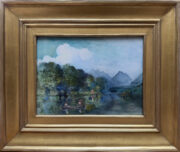
American (1835-1910)
Entrance to the River of Tautira, Man in Canoe, Pink Cloud, 1891
Watercolor on paperboard, Sheet 93/8 x x121/2 inches
Inscribed on verso with number and title from Henry Lee Higginson’s list of
pictures purchased between 1893 and 1895: “#11 Entrance to the river of Tautira. Man in canoe. Pink Cloud”
PROVENANCE
Purchase, Henry Lee Higginson, Boston, by 1895-d. 1919; his wife,
Mrs. Henry Lee (Ida Agassiz) Higginson, Boston, 1919-d. 1935; her nephew and his wife,
Mr. and Mrs. George Russell Agassiz, Boston, 1935-1951; Mrs. George Russell (Mabel
Simpkins) Agassiz, Boston, 1951-d. 1961; her niece, Mrs. Gordon C. (Anna Agassiz)
Prince, South Hamilton, MA, 1961-d. 1973; her husband, Gordon C. Prince, South
Hamilton, MA, 1973-d. 1983; his daughter, Mrs. Lillian Prince Margolis, Andover, MA,
1983-1985; her sister-in-law, Mrs. Gordon A. Prince, Weston, MA,1985-
EXHIBITED
Durand-Ruel Galleries, New York, Paintings, Studies, Sketches and
Drawings, Mostly Records of Travel 1886 and 1890-91 by John La Farge,25 Feb.
-25 Mar. 1895, no. 152; Societe Nationale des Beaux-Arts, Paris, France, Etudes, esquisses,
dessins: Souvenirs et notes de voyage (1886 et 1890-91) par John La Farge, 24 Apr.
-May 1895, no. 152; Museum of Fine Arts, Boston, “La Farge Memorial Exhibition,
” 1-31 Jan. 1911 (no cat.); Peabody Museum, Salem, MA, Exhibition of Paintings, Watercolors, and Drawings by John La Farge (1835-1910) from His Travels in the South Seas, 1890-1891, 1 Feb.-May 1 1978, no. 43
MANUSCRIPTS
Bancel La Farge, “[List of Lenders, Durand-Ruel Exhibition]” (New
Haven, Connecticut: Unpublished Ms., La Farge Family Papers, [1895]), no. 152; Henry
A. La Farge, “Catalogue Raisonne of the Works of John La Farge” (New Haven,
Connecticut: Unpublished Card File, La Farge Family Papers, [c. 1934-74]), card 413
ARCHIVAL SOURCES: BMFA, Prints and Drawings Department, Loan Card No.
1774.10 (1910)
Exhibited at Durand-Ruel in New York in 1895 as “Entrance to Tautira River. Study of
After-Glow. Tahiti. Society Islands, 1891. ” This was followed by the note:
I looked up the river in the light of the afterglow, which is the perpetual light of the
evening. One seemed to see everything accentuated and as in a dark mirror. The
reflections were those of the land; the natives crossed the water in boats for bathing
to places known by them; the red skins of the bare bodies of the men, the flaming
red of women’s dresses or their white gowns made spots like feathers of tropical
birds in the glassy reflections.